

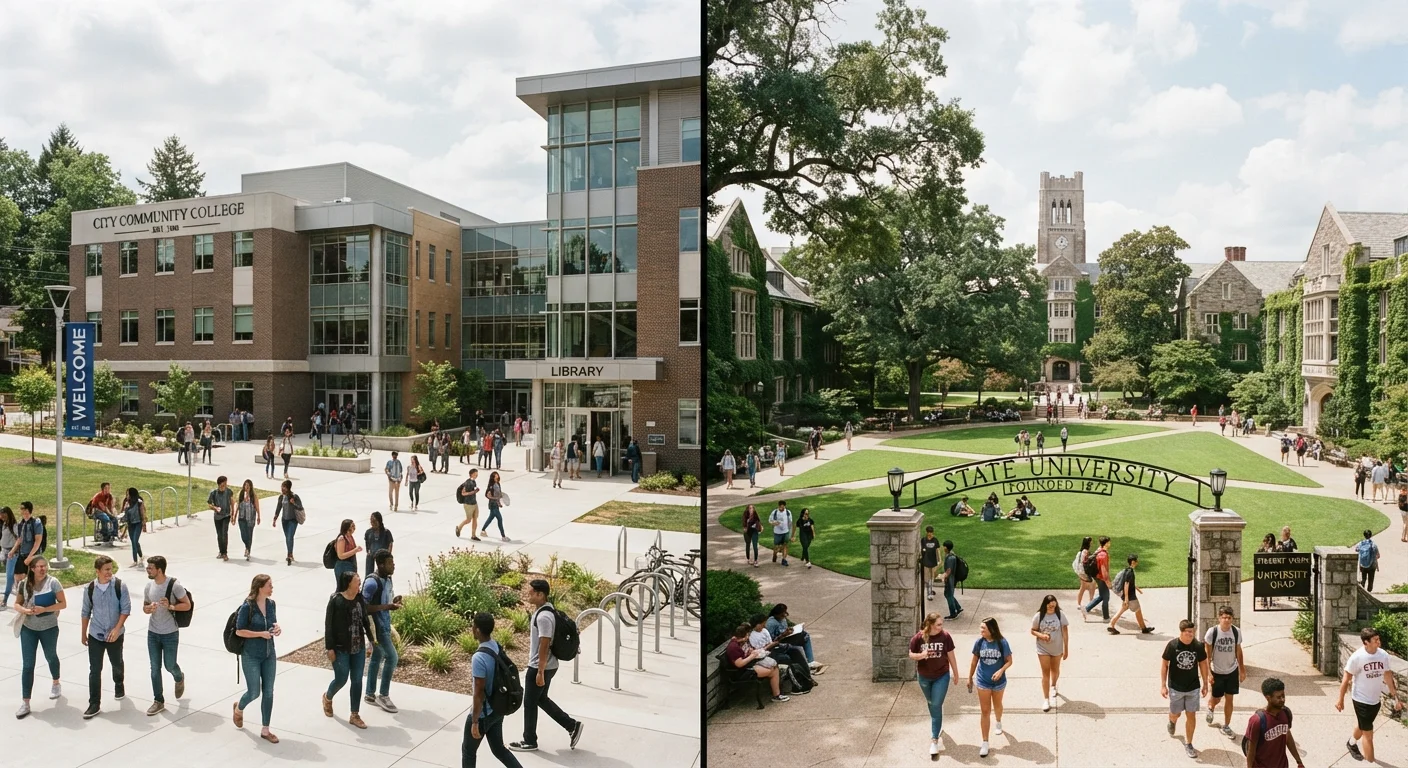
How tuition compares
According to the College Board's Trends in College Pricing data, the average published tuition and fees at public two-year colleges runs well under $4,000 per year. At public four-year in-state institutions, that figure is typically closer to $11,000 to $12,000 annually. Private four-year colleges average above $40,000. Those numbers cover tuition and fees only: they leave out room, board, books, and transportation.
For a student who spends two years at a community college before transferring, the savings on tuition alone can reach $15,000 to $20,000 compared with four years at a public university, assuming in-state rates throughout. The gap widens considerably against private institutions.
| Community college | Public four-year (in-state) | Private four-year | |
|---|---|---|---|
| Average annual tuition and fees | Under $4,000 | Approx. $11,000-$12,000 | Above $40,000 |
| Room and board (residential) | Minimal (commuter model) | $12,000-$15,000/year | $15,000-$18,000/year |
| Federal financial aid eligible | Yes | Yes | Yes |
| Credit transfer reliability | Varies by agreement | Receives transfers | Varies by institution |
| Typical credential outcome | Associate degree or transfer | Bachelor's degree | Bachelor's degree |
| Time to bachelor's degree | 4 years via 2+2 transfer | 4 years | 4 years |
Total cost of attendance: the fuller picture
Tuition is the most visible line item, but housing and food costs at four-year residential campuses typically exceed tuition at community colleges. A student who commutes from home while attending a local community college can hold living expenses to the cost of transportation and food at home, which most families already budget for. A residential four-year experience adds $12,000 to $15,000 per year in room and board at a public university, and more at private schools.
Community college students who must pay for off-campus housing independently may not save as much, since they lose the family home subsidy. Families should calculate the actual household cost difference, not just the published room-and-board figure, before assuming commuting is always cheaper.
Books and supplies run similarly at both institution types for most general education courses. Specialized program materials, lab fees, and technology requirements may differ by program.
Financial aid and the 2+2 transfer pathway
Federal financial aid, including Pell Grants and subsidized loans, is available to eligible students at accredited community colleges just as it is at four-year schools. Some students find their Pell Grant covers a significant share of community college tuition, making out-of-pocket costs very low. Many states also operate their own grant programs specifically for community college enrollment.
The 2+2 pathway involves completing an associate degree or two years of transferable credits at a community college, then transferring to a four-year university to finish a bachelor's degree. Several states have formal articulation agreements between their community college and university systems that guarantee credit transfer for students who meet grade requirements. California's TAG (Transfer Admission Guarantee) program and similar arrangements in Florida and Texas illustrate how structured these pathways can be.
Without a formal articulation agreement, credit transfer is less predictable. A student who takes courses not recognized by the receiving university may need extra semesters to complete degree requirements, erasing much of the cost advantage. Confirming transfer policies before enrolling is essential.
Just as with any major financial decision, the total cost picture matters more than the sticker price alone. Families navigating large purchases often find this true in other areas too: see our guide on the real cost of car ownership for a parallel look at how hidden costs add up beyond the headline number.
Credential value and career outcomes
For jobs that require a bachelor's degree credential, the institution that grants the degree matters less than the degree itself in many industries, particularly for early-career positions in fields like accounting, social work, and information technology. Employers in those fields focus on the credential and relevant skills.
In fields where graduate school is the next step (medicine, law, certain research sciences), undergraduate institution reputation can influence admissions outcomes, though it is not the only factor. Students with those goals should research the transfer records and graduate school placement of the specific community colleges and four-year schools they are comparing.
Associate degrees also have direct labor market value in fields like nursing (ADN), dental hygiene, electrical technology, and culinary arts. A student who completes an associate degree in one of these areas and enters the workforce may earn a strong return on a much smaller investment than a four-year graduate in a field with weaker employment outcomes.
What families should calculate before deciding
A straightforward comparison starts with four numbers: expected tuition at each option, expected room and board savings or costs, available financial aid at each institution, and the realistic time to degree completion given each pathway.
Net price calculators, available on every accredited college's website under federal law, provide a personalized estimate based on income and household size. These figures are more useful than published sticker prices for most families.
Families should also weigh how the student learns best, whether the community college has a strong track record of transfers to the target university, and whether the student has a clear enough academic direction to choose a transfer-aligned course sequence from the start. Changing direction mid-transfer plan can create credit inefficiencies that add cost and time.
This article is for general informational purposes only and does not constitute financial or educational advising. Families should consult directly with college financial aid offices and a qualified financial adviser when making decisions about education financing.