

Why pet food costs catch families off guard
Most families budget for pet food once, at adoption, and then watch the number creep upward each year. A medium-sized dog can consume 200 or more pounds of dry food annually. A cat, though smaller, still requires consistent nutrition across two or three meals a day. Those figures add up quickly, especially when a family is already managing a stretched grocery budget.
The pressure to spend more is everywhere at the pet store shelf. Premium positioning, appealing photography, and ingredient callouts are marketing, not nutrition science. A family does not need to spend at the top of the price range to feed a pet well. What matters is understanding what the food actually contains and whether it meets your pet's needs, not what the packaging promises.
Pet food spending also connects to broader household finances. For families tracking every dollar, practical money strategies for everyday household expenses apply to the pet food aisle the same as they do to the grocery store.
What your pet actually needs to stay healthy
Dogs and cats are not nutritionally interchangeable with each other or with humans. Each species has specific requirements for protein, fat, carbohydrates, vitamins, and minerals at different life stages.
AAFCO
The Association of American Feed Control Officials sets the nutritional standards that commercial pet foods must meet. An AAFCO statement on a label confirms the food provides minimum required nutrients for a stated life stage.
Obligate carnivore
An animal that must get certain nutrients from animal-based food because its body cannot produce them in sufficient quantities. Cats are obligate carnivores, which is why their dietary needs differ significantly from dogs.
Guaranteed analysis
The section of a pet food label listing minimum crude protein and fat percentages and maximum fiber and moisture percentages. It lets you compare nutrient density across different products.
Taurine
An amino acid that cats must consume through their diet because they cannot synthesize enough on their own. Insufficient taurine can lead to serious heart and vision problems in cats.
By-product meal
Processed animal parts beyond muscle meat, which can include organs and bone. When the animal source is named (chicken by-product meal), it can be a nutrient-dense ingredient; unspecified sources are harder to evaluate.
Life stage
A classification used on pet food labels to indicate which phase of an animal's life the food is formulated for: growth (puppies or kittens), adult maintenance, senior, or all life stages.
For dogs, protein from animal sources supports muscle maintenance, and fat provides energy. Puppies need higher caloric density than adult dogs. Senior dogs often benefit from adjusted protein levels, though this depends on kidney health and should be discussed with a veterinarian.
Cats are obligate carnivores. They require specific nutrients, including taurine and arachidonic acid, that they cannot synthesize in adequate quantities on their own. A cat fed a diet deficient in taurine can develop serious heart and eye conditions. This makes species-specific food non-negotiable regardless of budget.
The AAFCO nutritional adequacy statement on a food label indicates the product meets established minimum nutrient profiles for a stated life stage (growth, adult maintenance, or all life stages). This is the first filter to apply before comparing prices. General information about healthy eating on a budget for the whole family, including the humans, appears in resources like practical health and wellness habits that keep costs manageable.
Reading a pet food label without a science degree
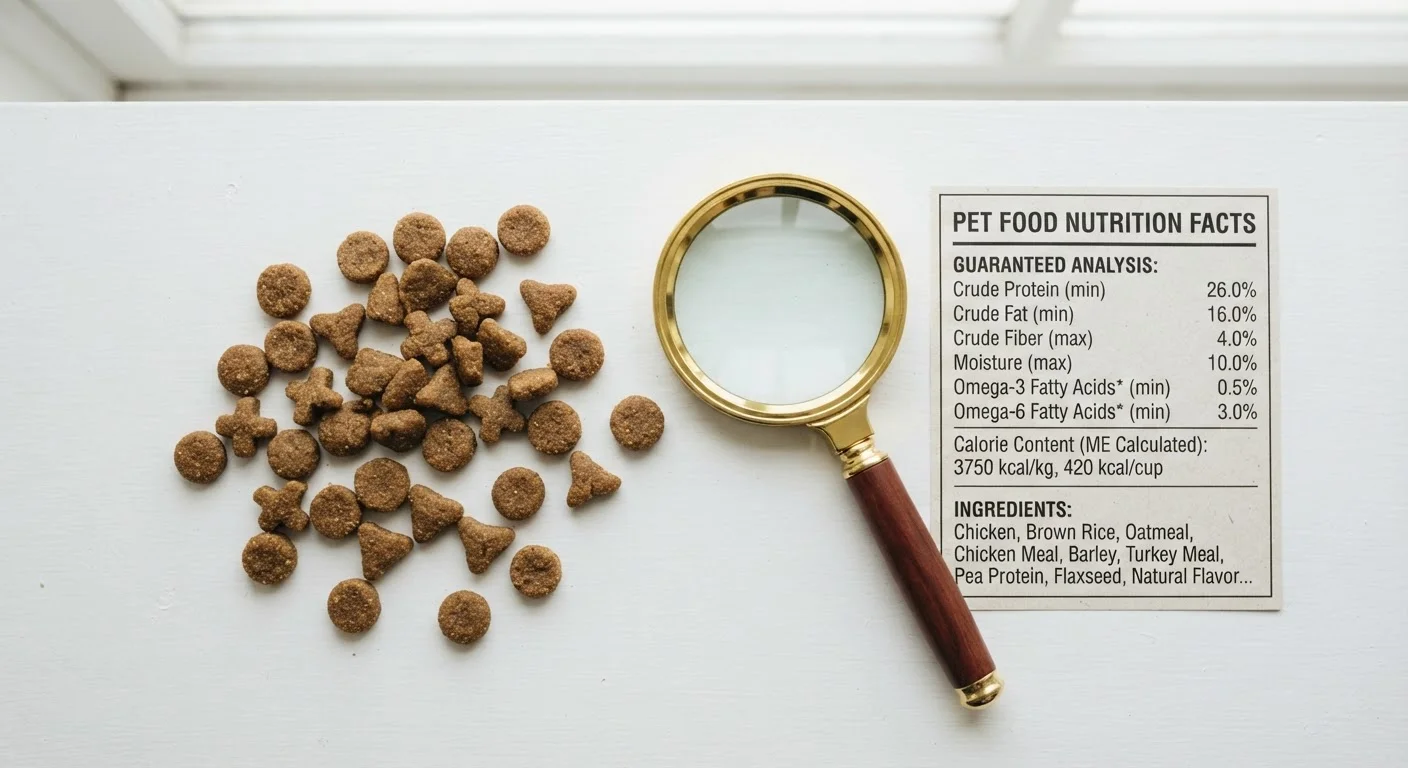
Two sections of a pet food label give you the most useful information: the ingredient list and the guaranteed analysis panel.
The ingredient list is ordered by weight before processing. A named protein source (chicken, turkey, salmon) appearing first or second signals that animal protein is a primary component. Ingredients like 'poultry by-product meal' are not automatically harmful; by-product meal can include organ meat, which is nutrient-dense. The concern arises when the protein source is entirely unspecified.
The guaranteed analysis panel lists minimum percentages of crude protein and crude fat, along with maximum percentages of crude fiber and moisture. These figures let you compare foods on a consistent basis, though the numbers alone do not reveal ingredient quality.
For a more detailed walkthrough of ingredient terms families encounter on budget pet food labels, this plain-language ingredient reference covers common terms and red flags without requiring a background in animal nutrition.
Portion sizing and its direct effect on your budget
Overfeeding is among the most direct causes of unnecessary pet food spending. A bag that should last four weeks runs out in three when portions are consistently larger than the animal needs. Beyond cost, excess calories contribute to weight gain, which veterinary research consistently links to shorter lifespans and higher healthcare costs.
Feeding guidelines on packaging are a starting point based on body weight ranges. They are not precise prescriptions. A less active indoor cat needs fewer calories than the package's high end of the range suggests. A working breed dog may need more. A veterinarian is the right source for a personalized target, particularly for pets with health conditions.
Use a kitchen scale for accurate portions
Measuring cups can vary significantly depending on how loosely or tightly the kibble settles. A simple digital kitchen scale gives you a consistent gram or ounce reading each meal. Over a month, consistent measurement can noticeably extend how long a bag lasts without reducing what your pet actually needs.
Measuring portions with a standard kitchen scale or a marked measuring cup rather than estimating by eye produces more consistent results. A small investment in a kitchen scale often pays back through reduced monthly food use.
Correct portions protect both your pet and your wallet, and the math behind this is more significant than most families expect at first.
Where to go next
This introduction covers the baseline: what pets need, how to evaluate labels, and why portion accuracy matters financially. The logical next step is understanding how food format affects both nutrition and cost.
A side-by-side look at dry kibble and wet food breaks down cost per serving and nutritional trade-offs for both formats, which helps families make a format decision grounded in facts rather than habit.
After that, practical strategies for reducing monthly pet food spending covers approaches like bulk purchasing and store-brand evaluation without sacrificing nutritional standards.
For families considering cooking for their pets as a cost-cutting measure, the real nutritional trade-offs of homemade pet food lays out what is genuinely at stake before committing to that path.
Finally, a monthly pet feeding audit checklist gives families a structured way to catch portion drift and spending leaks before they compound.
This article is for general informational and educational purposes only. It is not a substitute for professional veterinary advice. Consult a licensed veterinarian for guidance specific to your pet's health, diet, and medical needs.